"Gratitude makes sense of our past, brings peace for today, and creates a vision for tomorrow."
— Melody Beattie
I wasn't looking for this quote. I've shared it for years. But it found me again during a particularly rough Tuesday when I was questioning everything about my business model, my country, and whether any of us were doing okay.
Beattie, who wrote extensively about codependency and recovery, understood something fundamental: gratitude isn't about pretending things are fine. It's about finding solid ground when everything feels like it's shifting.
This year has tested us, not in subtle ways, but in ways that have left marks.
Did you feel it, too? The exhaustion that goes deeper than physical tiredness. The way conversations became minefields. The strange grief of watching relationships fracture over dinner tables and social media posts.
The sense that we've forgotten how to talk to each other, how to see each other, how to be a country together.
Here's what I know after 30 years of working with organizations in crisis: when things fall apart, gratitude isn't the soft option. It's the strategic one.
The Paradox of Gratitude in Hard Times
Gratitude doesn't erase difficulty. It coexists with it.
I lost 75% of my contracts overnight when USAID was shuttered. That's not a typo. The majority of my business. Gone. Colleagues, partners, and friends, all of us, together, experienced a profound sense of loss. You'd think gratitude would be the last thing on my mind.
But here's what happened instead.
The crisis forced me to question everything. Why was I doing this work? What did my clients actually need from me? What could I build that would matter more than what I'd lost?
Gratitude became my compass. Not the Hallmark card kind, but the fierce kind that says: I see exactly what's broken, and I'm choosing to build anyway.
What We've Forgotten About Each Other
We've turned each other into caricatures. The liberal elite. The ignorant masses. The flyover states. These aren't people anymore. They're categories. Labels. Enemies.
You know what's missing? Curiosity.
When did you last ask someone with different political views about their hopes for their kids? Not their voting record. Their hopes. When did you last listen to understand, rather than to out-argue the other person?
Common Ground's LEAD model includes gratitude at its core because grateful leaders see people, not positions. They recognize contribution before criticism. They build on strengths rather than fixate on weaknesses.
This isn't soft thinking. It's the hardest work there is.
The Stories We Don't Tell
During the holidays, if we're lucky, we share what we're grateful for. We go around the table with relatives and friends. We name the obvious things: health, family, jobs, homes.
But what about the complicated gratitudes?
I'm grateful for the client workshop that went completely off the rails. My carefully planned agenda crashed and burned two hours in. We had to pivot to pure listening, and what emerged was better than anything I'd scripted.
I'm grateful for the colleague who challenged every idea I had. She sharpened my thinking, even when some of her comments cut deep.
I'm grateful for the contracts I didn't win. They showed me I was playing the wrong game.
What are your complicated gratitudes? The losses that became lessons? The conflicts that clarified your values? The failures that freed you to try something better?
Finding Ourselves in Service
Here's something I've noticed after working all over the world: generosity transcends politics.
People fixing roofs after hurricanes without checking voter registration. Nurses holding the hands of dying patients without asking about their politics. Volunteers at food banks seeing hunger, not ideology. Parents carpooling each other's kids despite their Twitter wars. Coworkers covering shifts for family emergencies, even for the colleague they avoid at lunch.
Service reminds us who we are beneath the labels.
You want to find yourself again? Find someone to help. Not someone who looks like you, votes like you, or thinks like you—someone who needs what you have to give.
Make it specific. Make it local. Make it real.
Donate blood. Teach someone a new skill. Fix someone's computer. Share your expertise with a struggling nonprofit. Drive an elderly neighbor to appointments. Coach a youth sports team in a neighborhood that isn't yours.
Watch what happens when you stop seeing people as opponents and start seeing them as neighbors.
The Magic We Create Together
Magic isn't supernatural. It's what happens when humans decide to be human together.
I've seen it in hospital waiting rooms at 3 AM, where strangers become family, sharing phone chargers, terrible coffee, and hope.
I've seen it in youth development programs from DC to Kosovo, where kids who shouldn't get along become friends over soccer, food, and silly games.
We see it every time there's a disaster. People stop being Democrats or Republicans. They become humans with generators, humans with chainsaws, humans with water and sandwiches to share.
This magic isn't rare. We just stopped looking for it.
Practical Gratitude for Divided Times
Stop waiting for gratitude to feel natural. Make it a practice.
Write down three specific things you're grateful for each morning, or at night before you fall asleep. Not "family" or "health." Real things. "The way my daughter laughs at her own jokes." "My knees still working well enough to take stairs." "The barista or bartender who remembers my name."
Send one message of appreciation every day—text, email, call, whatever. Tell someone specifically what they did that mattered. Watch their response. Notice how it changes your day, too. Doing this one thing has quite literally kept me going at times.
Look for unexpected helpers. The political opponent who held a door. The difficult relative who asked about your work. The online stranger who shared useful information without snark.
Practice grateful disagreement. "I appreciate you sharing your perspective" isn't agreement. It's an acknowledgment. It keeps conversation possible.
Share your complicated gratitudes. Let people see you being grateful for hard things. It encourages them to do the same.
The Courage to Begin Again
Every generation thinks the world is ending. Every generation faces division that feels irreparable. Every generation has to choose whether to give up or begin again.
Beginning again takes courage. Not the dramatic kind. The daily kind.
The courage to see people instead of positions. To build bridges instead of walls. To choose curiosity over certainty. To practice gratitude when cynicism would be easier.
Common Ground exists because I believe in common ground. Not the myth that we will all agree, but the reality that we all want our kids and communities to thrive. We all want meaningful work. We all want to contribute to something that matters.
That's enough common ground to build on.
An Invitation for the Holidays
Don't pretend everything is fine. It isn't.
But also don't pretend that nothing is good. That isn't true either.
Sit with the complexity. Hold both/and. Be grateful for what works while working to fix what's broken.
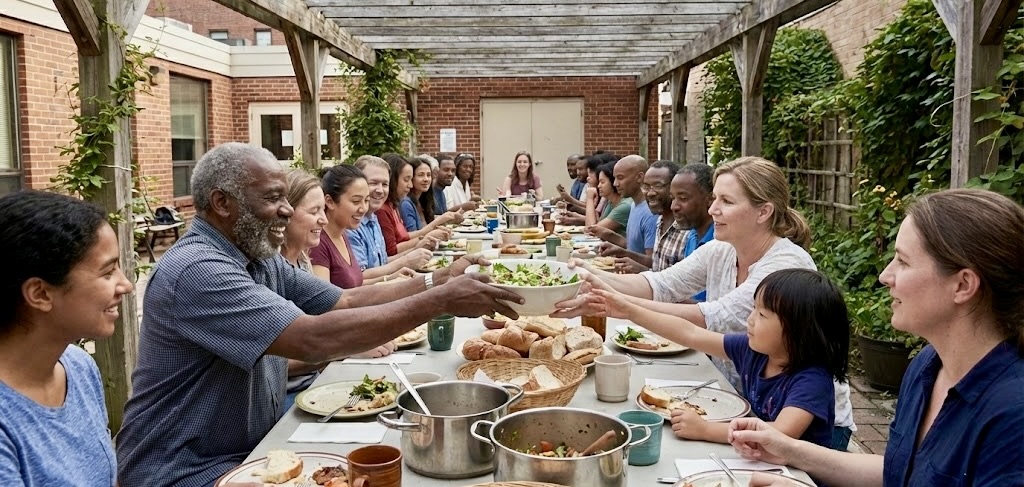
Share your table with someone unexpected. Please share your story with someone who needs to hear it. Share your skills with someone who could use them.
Remember that caring, generosity, and love aren't seasonal. They're choices we make or don't make every single day.
Find one person to thank unexpectedly. Find one assumption to question. Find one way to serve that stretches you.
Start there. Start small. Start now.
Because gratitude isn't about feeling better, it's about being better. And we need all of us to be better if we're going to find our way through this together.
The divisions are real. The pain is real. The challenges are real. So is our capacity to meet them. So is our ability to see each other as human.
So is the common ground beneath our feet, waiting for us to remember it's there.
This season, I'm grateful for the difficulty. It's showing us who we really are. And despite everything, I still believe that's good news.