The New Math of AI Infrastructure
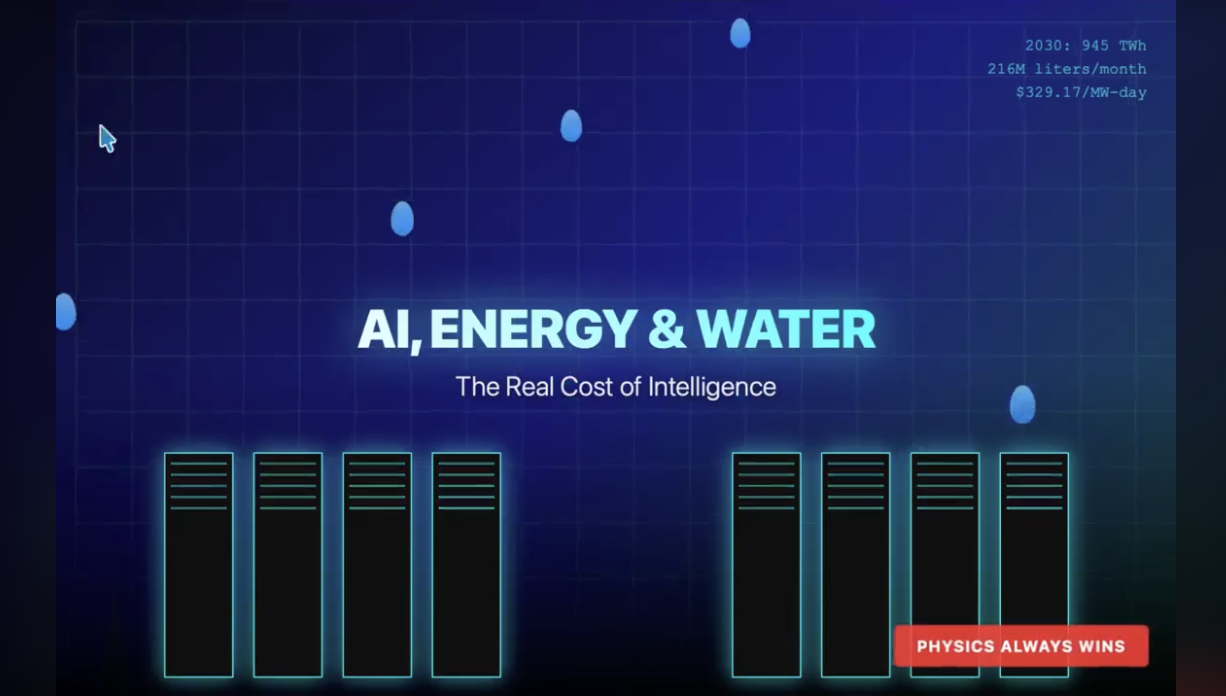
A balanced case for people who care about the planet and the future of AI.
I'm likely to lose friends on both sides of this debate. My conservation colleagues will think I've sold out to Big Tech. My AI teams will think I've lost my nerve about what we're building. Good. That means we're finally having the right conversation about AI's environmental footprint—one grounded in measurement, not mythology.
Let's Start With What A Single Prompt Really Costs
Public conversation often treats every AI query like a hidden smokestack. That makes for gripping headlines. It doesn't align with the most recent measurement tools and data.
Google's latest measurement puts the median energy, carbon, and water for a Gemini text prompt at 0.24 Wh, 0.03 g CO₂e, and 0.26 mL of water. [1] That's a few drops of water and roughly the energy of several seconds of TV.
Independent reporting and analysis tend to fall within the same ballpark for text prompts. The Washington Post notes that the climate impact of light, daily use is tiny, while reminding us that totals still matter. [2]
Truth bomb for the doom and gloomers: the impact is small. That matters for public perception and for everyday users. It does not settle the policy question.
Then Zoom Out To The System
The grid cares about totals and timing, not medians. In the United States, data centers consumed about 176 TWh in 2023, roughly 4.4% of U.S. electricity. [3,4] Depending on build‑out, that could reach 6.7% to 12% by 2028. [3,4]
Globally, the IEA projects data‑center electricity use to roughly double to ~945 TWh by 2030, just under 3% of world electricity in their base case, with AI‑optimized centers as the biggest driver. [5,6,7]
Local impacts are the flash point. In PJM—the region that includes Northern Virginia's "Data Center Alley"—capacity auction prices for 2026–27 hit the FERC‑approved cap of $329.17/MW‑day. [8,9,10,11] Grid planners cite a surge in expected data‑center load. This isn't abstract. This is your electricity bill.
In other words: While tech companies tout the tiny footprint of a single ChatGPT query, they're simultaneously planning facilities that will consume more power than entire cities. We're watching data centers transform from a rounding error in national energy statistics to the single biggest driver of new electricity demand in developed economies. And when grid operators are hitting emergency price caps just to keep the lights on, every AI interaction becomes part of a much larger reckoning about who gets power, at what cost, and whether our infrastructure can handle what's coming. The per-prompt statistics are a distraction from this reality: we're building an entirely new category of industrial-scale energy consumer, and doing it faster than our grids can adapt.
Put AI In Context With Other Growing Loads
AI is not the only new claim on electrons. The IEA's Global EV Outlook estimates EVs could draw about 780 TWh by 2030 under current policies. [12,13]
Space cooling is another giant. Analyses drawing on IEA data point to ~697 TWh of additional electricity for air conditioning by 2030. [14] Cooling saves lives in heat waves and will continue to expand. It also spikes demand when grids are already stressed.
Here's the uncomfortable truth: we're adding the equivalent of entire countries' worth of electricity demand across multiple sectors simultaneously. Singling out AI while ignoring AC is intellectually dishonest.
Water Is The Most Misunderstood Part
When Microsoft talks about 0.30 L/kWh WUE, [20] that sounds efficient. Until you multiply by a 1 GW training run over 30 days—that’s 216 million liters. In drought-stricken regions, that's not a statistic; it's a moral choice about whose tap runs dry.
Most headlines focus on on‑site cooling towers. The bigger slice is often indirect water tied to electricity generation. The latest U.S. assessment urges reporting both site and source water3 so decision‑makers see the whole picture.
Researchers led by Shaolei Ren show why timing and geography matter. By scheduling large jobs in lower‑carbon, lower‑water hours and locations, operators can cut both footprints without sacrificing results. [15,16,17,18]
Stop using 2019 water consumption data to fearmonger about 2025 AI. Back then, data centers relied almost entirely on evaporative cooling—essentially giant swamp coolers that consumed millions of gallons of water. Today's engineering has fundamentally changed. Closed-loop cooling recirculates the same water indefinitely, like your car's radiator, eliminating the need to draw from local water supplies constantly. District heating integration means data centers in places like Denmark and Finland now pipe their waste heat directly to residential neighborhoods, warming thousands of homes with energy that used to vanish into the atmosphere.
When a single facility can heat 100,000 homes while using zero fresh water, citing five-year-old consumption figures isn't just misleading—it's actively undermining serious environmental conversations. The technology has leapfrogged, while the talking points haven't. Refusing to acknowledge this progress makes environmentalists look unserious at precisely the moment when we need credibility to push for the next generation of improvements.
What Good Looks Like
While activists recycle old data, engineers have eliminated water cooling. Microsoft is deploying closed‑loop designs that use zero water for cooling19 in new sites, and reports a fleet‑wide WUE near 0.30 L/kWh. [20] These designs trade a bit of extra power for less local freshwater use—practical in arid regions.
Proper location siting helps, too. In the Nordics, companies and cities are piping data‑center waste heat into district heating networks—turning a liability into a local asset. Odense, Denmark, aims to donate approximately 100,000 MWh of server heat per year to homes. In Finland, Microsoft and Fortum plan systems expected to supply heat for up to 100,000 homes. [24,25,26]
Leaving gigawatts of heat to dissipate while people pay heating bills is obscene.
The "Frontier Run" Fear
Stop pretending frontier model training is just 'optimization.' A multi-GW facility is a small city's worth of power. Own that reality or lose your social license to operate.
By 2028, a single GPT-7-scale training run could draw more instantaneous power than the entire city of San Francisco. That's not hyperbole—it’s physics. As models scale, a single cutting‑edge training run could draw multiple gigawatts for weeks by 2030. Analysts place the high‑end power needs in the multi‑GW range, which will require special handling and dedicated clean power. [31]
The question isn't whether we should allow this, but where, how, and for what purpose.
Where AI Already Helps Public Missions
Last year, wildfire management using AI-guided strategies helped protect critical watersheds. The Forest Service's Potential Control Locations (PCL) Suitability model [27,29] uses machine learning and decades of outcomes to map where containment is most and least likely. FireCon [28,30] layers daily weather and operational factors on top of PCL so teams can choose tactics that actually work today.
That's not a tech demo. That's drinking water protection for millions of people—any environmentalist who dismisses AI wholesale needs to explain which of those acres they'd sacrifice.
The Opportunity Cost Argument
Every dollar and kilowatt spent on AI could go to proven climate solutions. But that assumes AI contributes nothing to those solutions. Consider what AI already delivers:
-
Energy optimization: Google's DeepMind reduced data center cooling costs by 40% using AI techniques now being applied across industrial facilities worldwide.
-
Grid reliability: Machine learning models predict renewable energy output 36 hours in advance, making wind and solar dependable enough to replace baseload power.
-
Wind farm efficiency: AI-designed layouts generate 20% more power from the same land area by optimizing turbine placement for wake effects humans can't calculate.
-
Materials discovery: AI has identified 2.2 million new crystal structures for next-generation batteries and solar panels—work that would have taken centuries using traditional methods.
-
Preventive maintenance: Power companies use AI to predict equipment failures before they cause blackouts, preventing massive emissions from emergency diesel generators.
-
Conservation targeting: The Nature Conservancy deploys AI to identify optimal reforestation locations, maximizing carbon sequestration per dollar spent.
When environmentalists frame AI as purely extractive, they're ignoring its role in making every other climate solution faster, cheaper, and more effective. Do the full accounting, not just the cost side—because the same GPU cluster training language models today could discover the breakthrough that makes grid-scale storage affordable tomorrow.
A Practical Middle Path
Stop shaming the prompt. Personal use of text‑only AI is not the problem. Save your political capital for the big decisions.
Here's what non-negotiable looks like:
-
No new data centers in water-stressed regions without 100% closed-loop cooling. Period.
-
Mandatory heat recovery in any region with district heating infrastructure - the technology exists and works. [21,24,26]
-
Real-time carbon and water intensity displays for every AI query over 1000 tokens - users deserve to see their footprint.
-
Training runs over 100 MW require published environmental impact assessments. Transparency isn't optional when you're reshaping the grid.
-
Full disclosures: site and source water reporting, [3] grid impact studies in tight regions like Northern Virginia, [8,9,10,11] and measurable community benefits.
-
Use time as a tool: schedule training and flexible inference to lower‑carbon, lower‑water hours. [15,16]
Tie AI to outcomes that matter—acres burned, days to containment, water saved, reliability improved. [15,16,27,28]
Here's What Matters
This will make everyone angry, which means it's probably right.
Per‑prompt impacts are small. System‑level growth is real. Local siting and water matter. AC and EVs will add even more load. We can hold all these truths at once and still make smart calls.
The comfortable position is to be vaguely concerned about AI's environmental impact while doing nothing concrete. That luxury is over. Either we shape AI's infrastructure trajectory now—with requirements, not suggestions—or we forfeit the right to complain when the bills come due.
Conservation groups: learn what WUE means. Tech companies: stop hiding behind per-prompt statistics when you're planning gigawatt facilities. The grid doesn't care about your ideology. Physics always wins.
Count everything. Site wisely. Schedule intelligently. Turn waste heat into value where it works. That is what responsible innovation looks like when you live in the real world.
A Personal Reckoning
You might wonder about the environmental cost of reading this article—or more precisely, the cost of my writing it. This piece originated from my own experience working with conservation groups and AI teams, but I drafted it through roughly 30 exchanges with Claude, involving document analyses, 20+ web searches, and multiple complex revisions. The ideas came from me, while the AI accelerated my research and helped refine my arguments. Using Google's published benchmarks as a proxy, this conversation consumed approximately 15-20 watt-hours of energy and 15-20 milliliters of water. That's enough electricity to run a laptop for 20 minutes and about a shot glass worth of water.
These numbers are almost comically small. The water wouldn't fill a coffee cup. The energy wouldn't toast bread. Yet this perfectly illustrates the maddening paradox at the heart of the AI environmental debate: our individual interaction is meaningless, a rounding error in the global energy system. But I'm one of millions having dozens of these conversations daily. Multiply my shot glass by a million. Now by a billion. Suddenly, you're talking about Olympic swimming pools.
This is why both camps in this debate drive me crazy. The tech optimists point to my 20-watt-hours and say, "See, it's nothing!" The environmental absolutists point to the 945 TWh projection and scream about the apocalypse.
Neither is lying. Both are missing the point.
The truth lives in the multiplication—in understanding how the trivial becomes tremendous at scale, and then deciding what we're going to do about it. Whether we're talking about shot glasses or swimming pools, the bill still comes due.
Glossary of Key Terms
BRA (Base Residual Auction) - PJM's annual capacity auction, where power generators bid to provide electricity capacity for future delivery years
Capacity Auction - A market mechanism where power generators commit to provide electricity supply years in advance, ensuring grid reliability
CO₂e (Carbon Dioxide Equivalent) - A standard unit for measuring carbon footprints, expressing various greenhouse gases in terms of CO₂ impact
Data Center Alley - Northern Virginia region hosting the world's largest concentration of data centers
FERC (Federal Energy Regulatory Commission) - U.S. federal agency regulating interstate electricity transmission and wholesale power markets
FireCon - USDA Forest Service tool using machine learning to predict daily fire containment suitability
Frontier Model/Run - Training of the most advanced, cutting-edge AI models requiring massive computational resources
GW (Gigawatt) - One billion watts; a large city like San Francisco uses approximately 1 GW of power
kWh (Kilowatt-hour) - Standard unit of electrical energy; the amount of energy used by a 1,000-watt appliance running for one hour
MW-day - Unit for capacity market pricing; the cost of reserving one megawatt of power generation capacity for one day
PCL (Potential Control Locations) - Forest Service AI model identifying optimal locations for wildfire containment
PJM Interconnection - Regional transmission organization managing the power grid for 13 states plus D.C., serving 67 million people
PUE (Power Usage Effectiveness) - Ratio of total facility energy to IT equipment energy in data centers; lower is better
TWh (Terawatt-hour) - One trillion watt-hours; annual electricity consumption unit for countries or large sectors
WUE (Water Usage Effectiveness) - Liters of water used per kilowatt-hour of IT energy in data centers; lower is better (industry metric)
Zero-water cooling/Closed-loop cooling - Data center cooling systems that recycle water without evaporation losses
Footnotes
-
Google Cloud Blog. "Measuring the environmental impact of AI inference." Aug 21, 2025. https://cloud.google.com/blog/products/infrastructure/measuring-the-environmental-impact-of-ai-inference
-
The Washington Post. Michael J. Coren, "ChatGPT is an energy guzzler. These things you're doing are worse." Aug 26, 2025. https://www.washingtonpost.com/climate-environment/2025/08/26/ai-climate-costs-efficiency/
-
Lawrence Berkeley National Laboratory. "2024 United States Data Center Energy Usage Report." Dec 19, 2024. https://eta.lbl.gov/publications/2024-lbnl-data-center-energy-usage-report
-
U.S. Department of Energy News. "DOE Releases New Report Evaluating Increase in Electricity Demand from Data Centers." Dec 20, 2024. https://www.energy.gov/articles/doe-releases-new-report-evaluating-increase-electricity-demand-data-centers
-
IEA Report. "Energy and AI -- Analysis." Apr 10, 2025. https://www.iea.org/reports/energy-and-ai
-
IEA News. "AI is set to drive surging electricity demand from data centres..." Apr 10, 2025. https://www.iea.org/news/ai-is-set-to-drive-surging-electricity-demand-from-data-centres-while-offering-the-potential-to-transform-how-the-energy-sector-works
-
IEA Report page. "Energy demand from AI." 2025. https://www.iea.org/reports/energy-and-ai/energy-demand-from-ai
-
Reuters. "Prices jump 22% in biggest US power grid energy auction." Jul 22, 2025. https://www.reuters.com/business/energy/prices-jump-22-biggest-us-power-grid-energy-auction-2025-07-22/
-
PJM News Release. "PJM auction procures 134,311 MW... price at FERC‑approved cap." Jul 22, 2025. https://www.pjm.com/-/media/DotCom/about-pjm/newsroom/2025-releases/20250722-pjm-auction-procures-134311-mw-of-generation-resources-supply-responds-to-price-signal.pdf
-
Utility Dive. "PJM capacity prices set another record with 22% jump." Jul 23, 2025. https://www.utilitydive.com/news/pjm-interconnection-capacity-auction-prices/753798/
-
Reuters. "America's largest power grid is struggling to meet demand from AI." Jul 9, 2025. https://www.reuters.com/sustainability/boards-policy-regulation/americas-largest-power-grid-is-struggling-meet-demand-ai-2025-07-09/
-
IEA. Global EV Outlook 2025 -- Outlook for energy demand. May 14, 2025. https://www.iea.org/reports/global-ev-outlook-2025/outlook-for-energy-demand
-
IEA. Global EV Outlook 2025 (PDF). May 14, 2025. https://iea.blob.core.windows.net/assets/7ea38b60-3033-42a6-9589-71134f4229f4/GlobalEVOutlook2025.pdf
-
Statista (via IEA data). "Projected global growth in final electricity demand by segment" -- space cooling +697 TWh by 2030. Jul 10, 2025. https://www.statista.com/chart/34785/projected-global-growth-in-final-electricity-demand-by-segment/
-
Li, Pengfei et al. "Making AI Less 'Thirsty': Uncovering and Addressing the Secret Water Footprint of AI Models." arXiv:2304.03271 (2023). https://arxiv.org/abs/2304.03271
-
Li, Pengfei et al. Communications of the ACM, "Making AI Less 'Thirsty'." 2024. https://dl.acm.org/doi/10.1145/3724499
-
Moore, H. et al. "Sustainable Carbon‑Aware and Water‑Efficient LLM Inference." arXiv:2505.23554 (2025). https://arxiv.org/abs/2505.23554
-
The Markup. "The Secret Water Footprint of AI Technology." Apr 15, 2023. https://themarkup.org/hello-world/2023/04/15/the-secret-water-footprint-of-ai-technology
-
Microsoft Cloud Blog. "Next‑generation datacenters consume zero water for cooling." Dec 9, 2024. https://www.microsoft.com/en-us/microsoft-cloud/blog/2024/12/09/sustainable-by-design-next-generation-datacenters-consume-zero-water-for-cooling/
-
Microsoft Datacenters -- Sustainability Efficiency page. Global average WUE 0.30 L/kWh (FY23). https://datacenters.microsoft.com/sustainability/efficiency/
-
Meta (Facebook) Odense project page. Goal to donate 100,000 MWh annually to district heating (≈6,900 homes). https://tech.facebook.com/engineering/2020/7/odense-data-center-2/
-
Meta Sustainability PDF on Odense heat reuse. https://sustainability.atmeta.com/asset/fb-denmark-data-center-to-warm-local-community/
-
Ramboll case: Odense surplus heat to district heating. https://www.ramboll.com/en-us/projects/energy/meta-surplus-heat-to-district-heating
-
Fortum: Microsoft data centres in Espoo & Kirkkonummi to supply ~40% of district heat (≈100,000 homes). https://www.fortum.com/data-centres-helsinki-region
-
BD+C: Nordic countries use data centers to warm homes (Espoo project). May 27, 2025. https://www.bdcnetwork.com/home/news/55292748/nordic-countries-use-data-centers-to-warm-homes
-
Helsinki Times: Data centers heating homes. May 21, 2025. https://www.helsinkitimes.fi/world-int/world-news/26920-data-centers-heating-homes-prepper-nation-of-the-nordics-and-u-s-remake-of-100-litres-of-gold-finland-in-the-world-press.html
-
USDA Forest Service: Potential Control Locations (PCL) Suitability Model. https://research.fs.usda.gov/rmrs/products/dataandtools/potential-control-location-suitability-model
-
USDA Forest Service: FireCon -- Daily Fire Containment Suitability. https://research.fs.usda.gov/rmrs/products/dataandtools/firecon-daily-fire-containment-suitability
-
FRAMES Catalog: PCL and FireCon entries. https://www.frames.gov/catalog/70622 and https://www.frames.gov/catalog/70621
-
Epoch AI / EPRI analyses on frontier training power (summary of multi‑GW ranges). Example overview: https://arxiv.org/abs/2505.23554
-
Referenced in text as analyses placing high-end power needs in multi-GW range.